
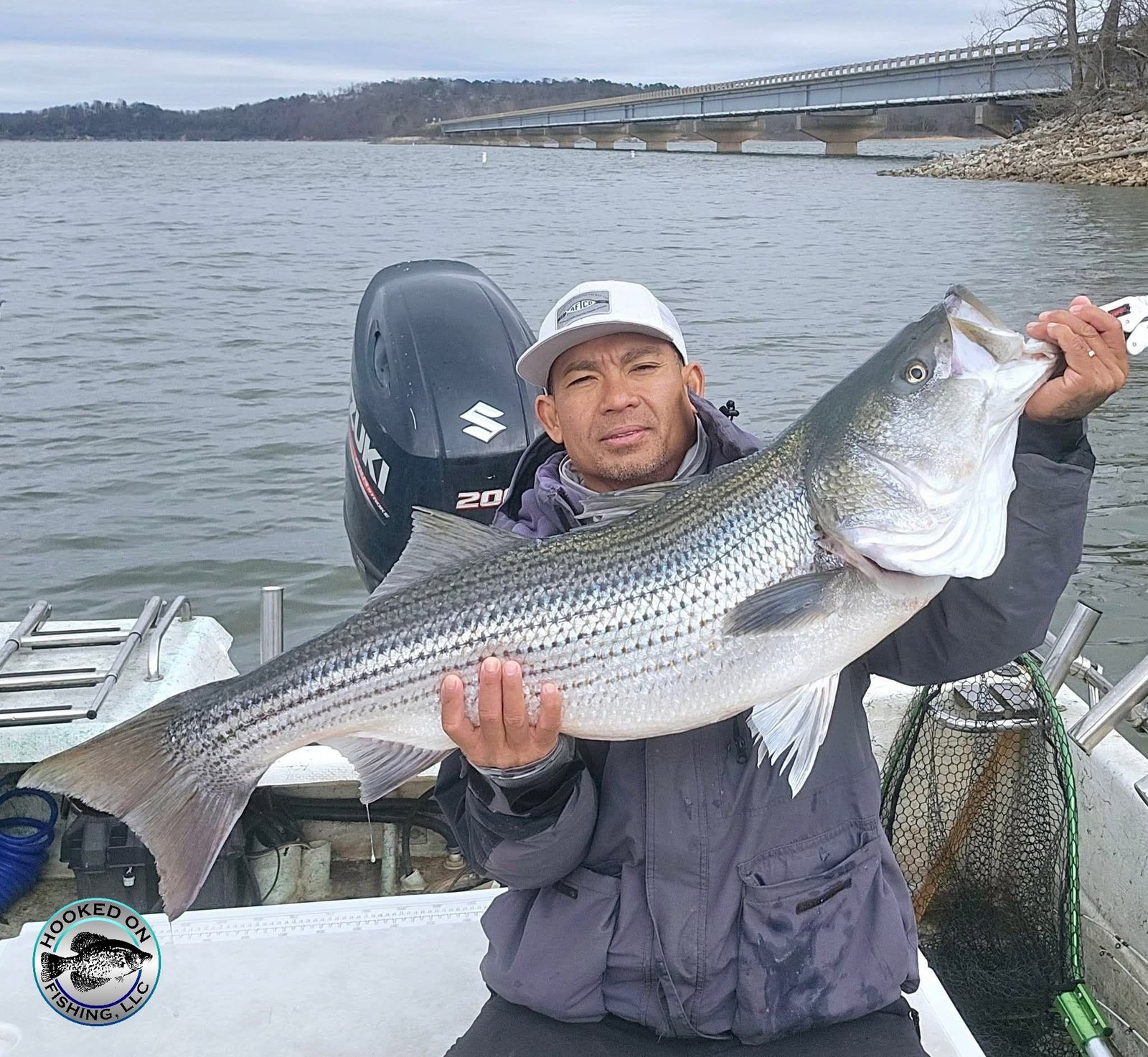
When summertime water temperatures climb, catching a trophy striped bass changes from a thrilling victory into a race against the clock. Even if a striper looks perfectly healthy, swims away strong, and splashes you upon release, there is a high probability it will die hours or days later.
This phenomenon is known as delayed mortality. It is one of the most critical challenges in fisheries management, particularly in deep, southern reservoirs.
Here is an in-depth breakdown of the science behind why summer delayed mortality happens, the physical toll it takes on the fish, and what it means for anglers.
1. The “Thermal Squeeze” Phenomenon
Striped bass are fundamentally cool-water fish. Their biological sweet spot is water between 55°{F} and 68°{F}, and they require high dissolved oxygen (DO) levels—ideally above 4 to 5 mg/L—to thrive.
In the summer, deep reservoirs undergo thermal stratification, splitting into three distinct layers:
The Epilimnion: The upper layer. It is highly oxygenated due to wind and wave action, but it becomes dangerously hot (often exceeding 80°F to 85°F).
The Hypolimnion: The deep, bottom layer. It remains cold, but as the summer progresses, decaying organic matter consumes all the oxygen, turning it into a hypoxic “dead zone.”
The Metalimnion (Thermocline): The middle layer where temperature drops rapidly.
As July and August roll around, stripers get trapped in a thermal squeeze. The oxygen runs out down deep, forcing them up into the hot water, or the heat forces them down into low-oxygen water. They tolerate this by holding in the absolute narrowest sliver of the thermocline where they can barely breathe and stay cool. They are already living on the edge of survival before you ever hook them.
2. The Physiological Toll of the Fight
When an angler hooks a striper in 80°F + surface water, a destructive chain reaction begins inside the fish’s body.
Severe Lactic Acidosis
Because the water is hot and low in oxygen, a fighting striper cannot fuel its muscles using normal aerobic respiration. Instead, it switches to anaerobic metabolism. This burns energy stores rapidly and creates a massive buildup of lactic acid in the muscle tissue, which spills into the bloodstream.
Think of it like a human sprinting a marathon at top speed without taking a single breath.
The blood pH drops drastically (acidosis). If the fight is prolonged, the pH drops past a point of no return, causing systemic organ failure hours after the fish is released.
Oxygen Debt & Suffocation
A fish’s metabolic rate doubles or triples in warm water, meaning it requires vastly more oxygen to survive in summer than in winter. However, warm water naturally holds less dissolved oxygen.
When you pull a striper out of the thermocline, through the hot surface water, and into the air, its gills completely collapse. A 60-second countdown in the air during August is equivalent to holding a human’s head underwater for several minutes after they just ran a sprint. The fish incurs an massive oxygen debt that its compromised cardiovascular system cannot easily repay.
Osmoregulatory Shock
Freshwater fish must constantly pump water out of their bodies to maintain the correct balance of salt and fluids (osmoregulation). Severe stress breaks down the mucous membrane (slime coat) and damages the cellular lining of the gills. This allows water to flood into the fish’s circulatory system, causing cellular swelling, kidney strain, and eventual death.
3. Why the “Good Release” is an Illusion
The most frustrating aspect of delayed mortality for conservation-minded anglers is that you rarely see the fish die.
When a striper is released, a sudden surge of adrenaline and cortisol (the stress hormone) allows it to give a powerful tail-beat and swim down out of sight. Anglers high-five, thinking it’s a successful release. However, once that adrenaline wears off over the next 2 to 24 hours:
The overwhelming lactic acid load triggers muscle rigidity and cardiac arrest.
The fish becomes disoriented, loses its equilibrium, and cannot stay upright in the water column.
Sinking to the bottom, it becomes easy prey for catfish or simply suffocates because it cannot swim forward to pass water over its gills (ram ventilation).
Telemetry and cage studies conducted by state wildlife agencies (like the AGFC and TWRA) consistently show that during peak summer heat, mortality rates for released striped bass caught from deep water can exceed 50% to 70%, regardless of how gently they were handled.
4. Mitigating the Damage:
Best Practices If you are targetting stripers when surface temperatures cross the 80° F mark, strict adjustments are required to keep the fishery sustainable:
Heavy Gear, Short Fights: Put away the medium-light action rods. Use heavy-action rods and high-test line to winch the fish to the boat in under two minutes. Do not let the fish play out and build up lethal levels of lactic acid. Keep Them in the Water:
Leave the fish in the net over the side of the boat while unhooking it. If you must take a photo, have the camera ready, lift the fish for a count of three, and put it back. No air is the golden rule.
Circle Hooks Only: If fishing live bait (like shad), use non-offset circle hooks to eliminate gut-hooking. A gut-hooked fish in summer has a near-zero percent chance of survival due to combined bleeding and heat stress.
The “Catch Your Limit and Quit” Policy: Summer is not the time for high-volume catch-and-release fishing. Many veteran guides and conservationists shift to a “limit out and go home” mindset. Once you hit your legal retention limit, switch targets to a hardier species like bluegill, catfish, or largemouth, which handle warm-water handling significantly better.
Wow! Thanks for the science behind all this Austin. I first learned of this phenomenon when son Jeff first went to Milford. A guide buddy up there let him know how easily wipers died in the summer. I haven’t graduated to a heavy action rod yet, but I use medium, and don’t take an inordinate time to get one in. Makes you think though – sorry thing to put them to waste like that. Thanks again for this good information.
Thank you! I appreciate you taking the time to read it. Your guide buddy at Milford was absolutely right—hybrid stripers and stripers can be especially vulnerable during the summer months when water temperatures climb and dissolved oxygen levels drop.
It sounds like you’re already doing many of the right things by using appropriate tackle and getting fish to the boat efficiently. The challenge is that even when a fish appears healthy and swims away strong, delayed mortality can still occur hours later due to physiological stress. That’s what makes this issue so easy to overlook.
The goal of the article wasn’t to discourage people from fishing for stripers, but rather to help anglers understand what’s happening and make informed decisions during the hottest parts of the year. The more we know, the better we can protect these fisheries for future generations.
Xieng is extremely passionate about striper fishing and conservation, and I thought he did an outstanding job breaking down a complicated issue in a way that anglers can understand. His knowledge and firsthand experience with the fishery really shine through in this article.
Thanks again for sharing your experience and for taking the time to join the conversation.